Showing posts with label sketchbook. Show all posts

Monday, 1 February 2021

Drawing every day

Last year I watched as Debbie Mackinnon started a project to draw every day. She kept to this resolve. Every. Single. Day. 366 days. A remarkable achievement indeed. 
She has just had a successful exhibition at Incinerator Gallery in Sydney showcasing the results. 
These drawing prompted me to follow her example this year. 

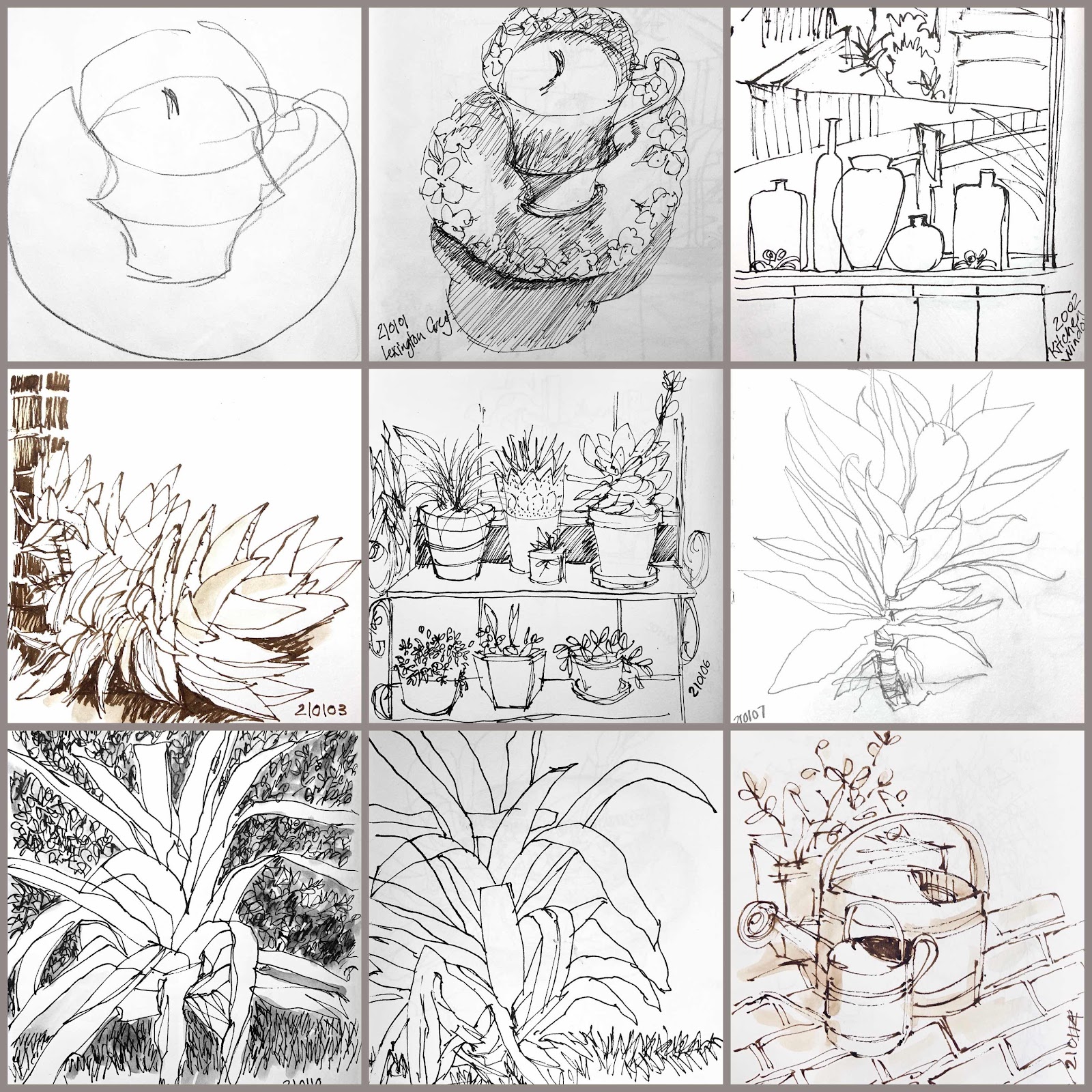
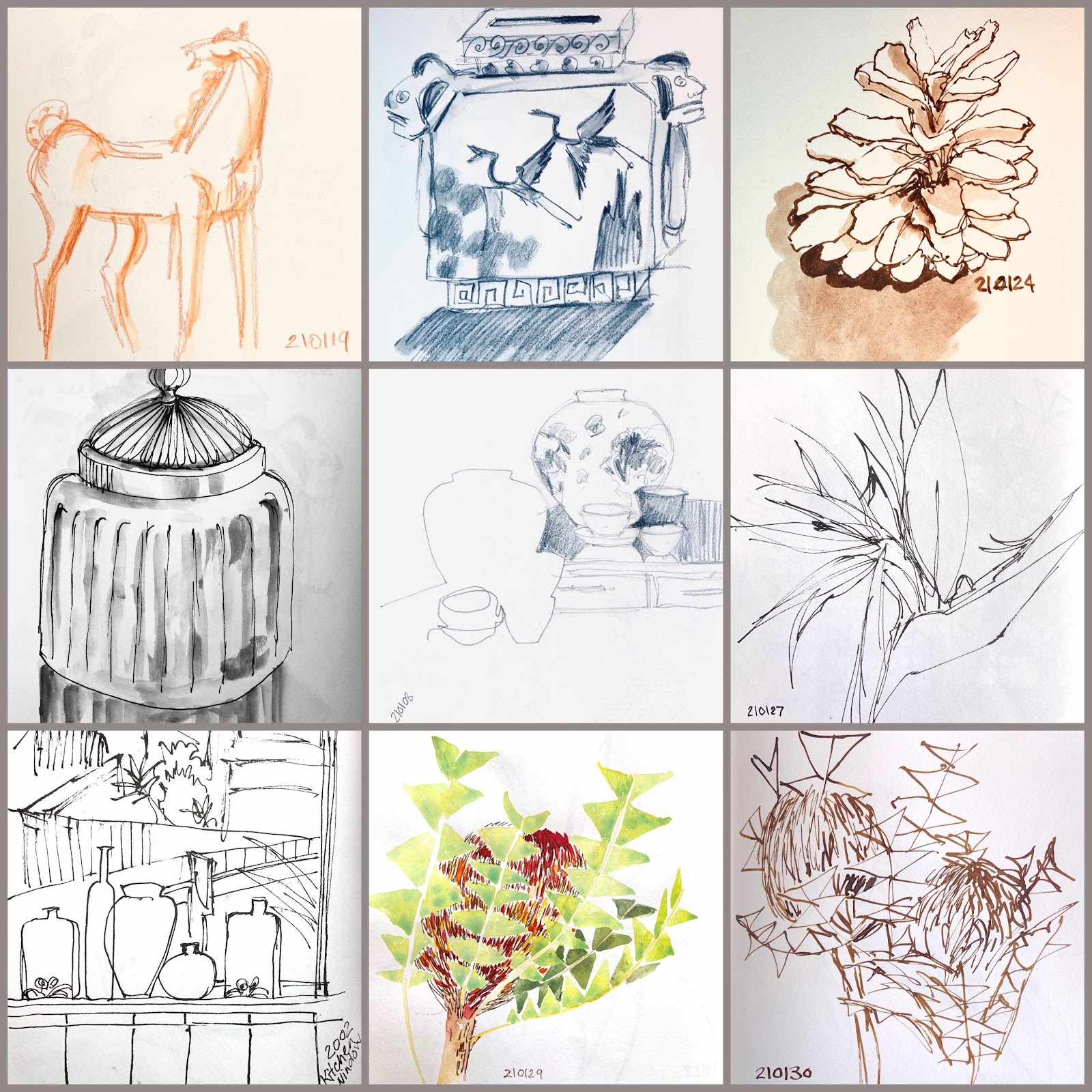
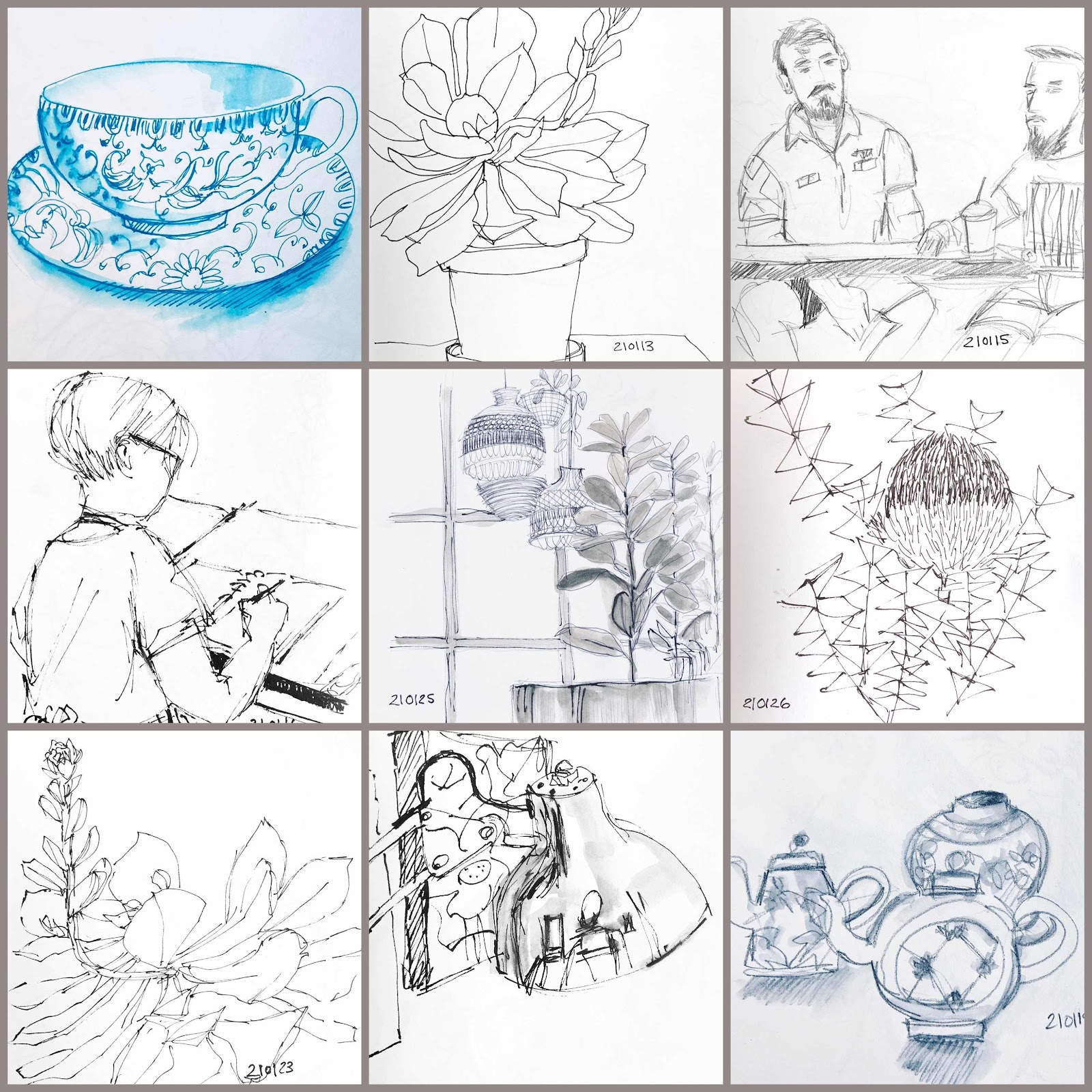
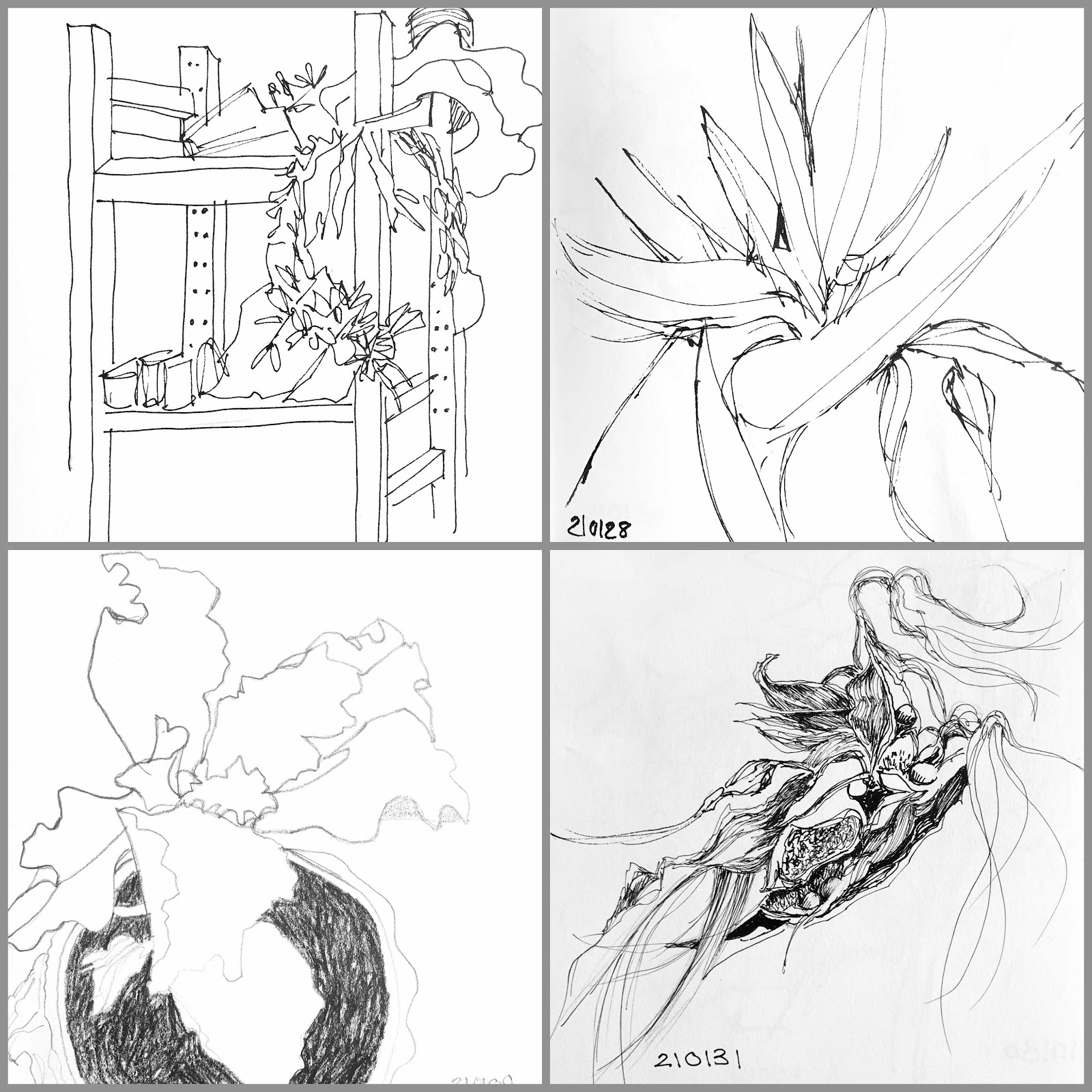
So we are one month down in 2021 and I have 31 drawings done. I decided at the outset that I would start small and do a very quick drawing every day. Apart from a couple of days when I got sidetracked with re-opening the Studio, I kept to the schedule. (I have since made up the days missed!)

I used a relatively small sketchbook 19cm x 19cm so that I could do something easy and undemanding. Deciding that done was better than perfect.
The small format is somewhat restrictive so I foresee that I will branch out and experiment with larger paper and a use variety of media.


Thursday, 28 March 2013

Testing the Beta Sketchbook


The choice and quality of drawing tools is very important for an artist.  Last year I was given the opportunity to work with a number of the exciting Derwent drawing pencils and Artbars. So, too, the paper used has a big part to play in the final result of a drawing or painting.

I have discussed various sketchbooks on Art Matters as my search continues for the perfect book. There are a number of criteria - the quality of the paper; the responsiveness to a variety of media - i.e. is it suitable for pencil, ink and watercolour; the size of the book; the robust quality of the binding and the cover.

I am definitely prejudiced in favour of bound books, never having liked the mechanical feel of a ring-bound book. I like to have the freedom to paint and draw across the gutter and, moreover, I just love a proper book. However, Stillman & Birn books come in both Hardbound and Wire-bound formats so everyone can be satisfied.

The new journals produced by Stillman & Birn have been in the news on drawing and sketching blogs all over the world. These sketchbooks are now available here in Australia. I have been given one of the Beta 14.0 x 21.6cm sketchbooks to try.

The Specs:
The paper in the Beta is 180Lb./270 GSM;
Natural White
Cold Press surface
For Multi-media work
There are a number of different sizes in each of the series. I haven’t tested any of the others yet so I will confine my comments to the Beta series.

The binding is extremely strong and if broken in correctly (yes, it’s recommended that you are tough with the book when you get it) will open completely flat. The cover has a good surface that will stand up to being thrown around without starting to look shabby.

I started off with a simple pencil drawing, and then tried the same subject in watercolour only.


A spray of bougainvillea from my early morning walk provided the subject for trying ink with watercolour. This I followed with a detailed drawing of a Chinese Dragon vase using a very fine pen - the Platinum Carbon pen. 

The final sketch in the first series of tests was a plein air drawing of The Old Windmill in Spring Hill, Brisbane. For this drawing I used a Pigma Micron 005 and watercolour.

The Old Windmill in Spring Hill, Brisbane.

Although I have done only a few sketches to date, I found that the paper responded very well to all types of media with good results. I’m looking forward to more drawing fun over the long weekend.

A Blessed and Peaceful Easter to all who will celebrate this special time.


Thursday, 14 October 2010

Drawing - a thin black line

Why do we assume that we need a special talent for drawing? Often people profess to have no talent for drawing, saying – “I can’t even draw a straight line”.
When shown that they can draw – they declare that they must have a hidden talent.

We don’t make that assumption about other talents like reading. What if only those with a special talent could learn to read? The teachers would supply reading materials; not guide or instruct the class for fear of hampering creativity in reading. Then the teacher would sit back and wait to see what would happen.
The kid says, “How do I read this?” The teacher replies: “Just be free, use your imagination - reading should be fun.” Some of the class would be able to read but the rest would say: “I can’t read – I have no talent”.

We apply this strange reasoning to teaching art. We are too afraid to instruct for fear of hampering or diminishing the child’s creative spirit.
Drawing is in reality a way of learning how to see. We can learn to hone our powers of observation with the result that almost anyone can learn to draw.

In a previous post, when I was considering all the different types of media I have used over the years, I left out the two simple tools for any artist that have always been used – a lead pencil and an ink pen. I love buying new pens and pencils – I am happiest in an art supply store or even a basic stationery store. I have become addicted to finding new pens that will help me draw better.

Pier at Blankenberg
Whenever I traveled anywhere, first into the suitcase would be a sketchbook, pencils, pens and a small watercolour box and a brush or two (although I never seemed to get around to adding much colour.) 
Departing ferry, Breskens


These sketchbooks became a visual diary, capturing people and places.
Paging through them takes me back to the experience of different countries more vividly than any photograph album.

Ferry Harbour, Breskens

Pen and ink drawing can provide drama, strong contrast and fine detail. The sketch below was done in the Museum Skone Kunst, Antwerp. I came across an artist painting a copy of Fouquet's Maria and Jesus surrounded by Angels, and couldn't resist doing a sketch of her.


Sketching the copyist in Antwerp, Belgium

Recently, I have experimented with drawing on alternative surfaces such as ink on canvas or on a wooden panel, adding a new dimension to drawing.


Seeds and Leaves 382mm x 760mm  Ink on canvas
It takes courage to draw in ink – there are no second chances – no way to erase the errors. Instead, one has to really look at the subject, focus on where you want the line to go, and execute it fearlessly with a clean fluid line

Protea Cyranoides 200mm x 200mm Ink on Hahnemule paper
©2010 Carol Lee Beckx
I have always enjoyed drawing, it almost becomes a meditation as you hatch the lines to create tone, or trace a fine thread of ink across the paper to show a delicate outline.

David Lloyd George said: “Anything can be achieved in small deliberate steps. But there are times you need the courage to take a great leap; you can’t cross a chasm in two small jumps”